

You wouldn’t be reading this if you hadn’t already tried something.
Maybe you walked into a rehab program hopeful—or at least open. Maybe you stayed sober for a bit. Maybe you relapsed a week, a month, or a year after discharge. Or maybe you never really engaged, even though you showed up. Whatever your path looked like, the end result felt the same: it didn’t work.
And now you’re left wondering: Was it me? Was it the program? Or is this just hopeless?
We want to say this as clearly as possible: You’re not the only one asking those questions. And you’re not wrong for asking them.
Alcohol addiction rehab doesn’t “fail” because someone didn’t want it badly enough. It doesn’t fall apart because you were broken beyond help. If treatment didn’t work for you—or for someone you love—there are real, concrete reasons that might have happened. And many of them are fixable.
Let’s talk honestly about what gets in the way of recovery—and why it might be different next time.
Rehab Isn’t Magic. It’s Structure, Timing, and Fit.
There’s a myth that rehab is like a reset button. You go in, detox, talk to a few counselors, get some strategies—and come out clean, clear, and whole. But anyone who’s actually been through it knows better.
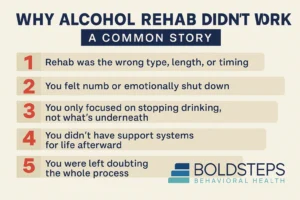
Here’s the truth: Rehab is a start, not a fix. And if you weren’t in the right type of program—or if the timing wasn’t right—it may not have stuck.
Some people need more structure than others. Some need a longer runway to trust. Some need dual-diagnosis care for trauma, anxiety, or depression that feeds the drinking. And if your program didn’t account for those layers, it may not have been able to reach you.
You didn’t fail. The plan just didn’t match the problem.
If You Felt Numb, Flat, or Guarded—That’s Normal
It’s incredibly common to go through rehab feeling like you’re not really in it. Maybe you sat in group, listened politely, even journaled a little. But emotionally? You were on lockdown. You didn’t cry. You didn’t share. You were waiting to feel something that never really came.
That isn’t resistance—it’s protection.
When someone has been hurt, judged, or dismissed over and over, the brain builds armor. Especially if the alcohol was how you coped for years. You don’t just walk into a group room and hand over your truth. You test the waters. You survive the day. You stay safe.
And that’s okay.
But the kind of healing that changes your life? It happens when treatment meets you with safety, not just structure. When the people around you aren’t just trained—they’re real, emotionally intelligent, and trauma-aware. If that wasn’t your experience last time, it makes sense that rehab felt empty.
Maybe the Program Focused on Stopping Drinking—Not Why You Drank
This is one of the biggest reasons treatment doesn’t land: it targets the behavior, but not the why.
Drinking is a symptom. It’s a coping mechanism. For some, it’s about numbing trauma. For others, it’s how they manage social anxiety, grief, or stress. And sometimes, it’s just what you were raised around.
If your last program focused only on the drinking—without exploring what it was doing for you—it might’ve felt like someone yanked away your only life raft without offering anything else.
At Bold Steps New Hampshire, we approach alcohol addiction rehab differently. We believe you deserve care that sees your whole story. Not just the substance—but the pain, the patterns, and the person underneath.
Aftercare Matters More Than People Think
Let’s be honest: Discharge day isn’t always a triumph. For many, it’s the start of the most vulnerable chapter in recovery.
You go back to your same apartment, same triggers, same stressors. But now you’ve got a binder of worksheets and no support system.
That’s not recovery—that’s a setup.
A strong treatment program includes aftercare planning: relapse prevention tools, sober community access, mental health follow-up, housing support if needed, and ongoing check-ins. If no one helped you plan for life outside of treatment, of course it didn’t stick.
You’re not weak. You were under-resourced.
Real Talk: You’re Allowed to Be Skeptical
Some people feel ashamed for even thinking that rehab didn’t work. Like they’re betraying the system or admitting defeat.
But let’s clear that up: being skeptical is a healthy response to disappointment. If you spent time, money, and emotional energy on something that left you empty-handed—it’s okay to say, “That didn’t help.”
What matters now is what you do with that truth.
Maybe it’s trying a program that takes a different approach. Maybe it’s starting with therapy instead of full rehab. Maybe it’s outpatient care with more flexibility. Or maybe it’s just a conversation—with no pressure to commit.
There’s No One Right Way to Recover
This is not a prescription. It’s a permission slip.
You are allowed to find your own rhythm. Some people find recovery through inpatient rehab. Some through outpatient groups. Some through therapy, community, faith, or mutual aid. Some go back to treatment more than once—and each time, it lands a little differently.
If you’re reading this from Concord or nearby towns in Merrimack County, Rockingham County, or Hillsborough County, know this: You have options. Real, human, tailored-to-you options. That includes the work we do here at Bold Steps.
You don’t have to choose today. But you deserve to know what’s possible.
Real Talk from a Peer
“My first time in rehab, I left after two weeks. I told everyone it was a waste of time—but really, I was just scared it wouldn’t work, and I didn’t want to find out. The second time, I was honest. I told them I didn’t trust anybody. They didn’t try to fix me. They just sat with me until I could.”
— Outpatient Client, 2023
Frequently Asked Questions About Alcohol Addiction Rehab
What if I’ve already been to rehab more than once?
That doesn’t disqualify you. In fact, many people need more than one attempt—not because they failed, but because healing is complex. With each experience, you gain insight into what you need, what didn’t help, and what might work better.
How is outpatient rehab different from inpatient?
Outpatient rehab allows you to live at home while attending structured therapy and support sessions. It works well for people who have responsibilities they can’t step away from—or who need a more flexible, integrated recovery path.
Learn more about our alcohol addiction rehab options in Concord, NH.
What if I don’t feel ready to stop drinking completely?
You don’t have to be ready to commit forever. Many people start by exploring what drinking does for them and whether it’s still serving them. You can begin with curiosity, not certainty.
Can I afford treatment?
We work with most major insurance plans and offer multiple levels of care—including outpatient programs with lower costs than residential rehab. Call us to walk through your options with zero pressure.
You’re Not Starting Over. You’re Starting From Experience.
If you’re thinking about trying again, here’s what we want you to know:
You’re not broken. You’re not behind. And you’re not too late.
You’re someone who already knows what didn’t work—and that gives you a head start in figuring out what might.
Whether you need a space to talk, a new kind of support, or just someone who won’t promise the moon—we’re here.
Want to talk it through with no pressure?
Call (603) 915-4223 to learn more about our Alcohol Addiction Rehab services in Concord, NH.