

You left. Or maybe you drifted away. One day turned into three. Then it felt too awkward to come back. Or you meant to, but the anxiety in your chest said otherwise. Or maybe you got tired of saying things no one seemed to hear.
Whatever happened—you’re here now. Which means part of you still wants healing. Still wants help. Still believes that maybe this time could be different.
This blog isn’t about fixing you. It’s about helping you create a dual diagnosis treatment plan that doesn’t ignore who you are. One that honors both your substance use and your mental health. One that can survive your messy days—and maybe even help you through them.
Step 1: Start Where You Actually Are (Not Where You Think You Should Be)
Before you make a single plan, take a breath.
You do not need to “get it together” to be worthy of care. You don’t need to erase your dropout or make excuses. You’re allowed to say, “I left.” Period.
You’re also allowed to say, “I don’t know if I want to come back, but I’m thinking about it.” That’s honest. That’s brave.
Starting over doesn’t mean starting from scratch. It means picking up where you are and building something better from there.
So ask yourself honestly:
- What are you dealing with today—emotionally, mentally, physically?
- What feels tolerable? What feels impossible?
- What kind of support doesn’t make you want to run?
That’s your real starting point.
Step 2: Name What Didn’t Work Last Time
If you ghosted treatment, something didn’t line up. And it’s not just on you.
- Maybe the groups felt too intense.
- Maybe you couldn’t connect to anyone.
- Maybe you weren’t ready for trauma work.
- Maybe the hours clashed with your real life.
- Maybe the vibe just sucked.
Whatever the reason, it matters. And no one builds a better plan by pretending the past didn’t happen.
Write it out. Say it out loud. Tell the truth: “That didn’t work for me.”
At Bold Steps in Concord, NH, we hear this all the time—and we welcome it. It helps us do better for you.
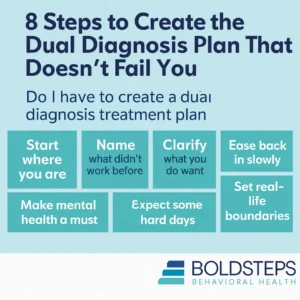
Step 3: Clarify What You Do Want from Treatment
This part is crucial: If you could build your ideal treatment plan, what would it include?
Here are some prompts to get you thinking:
- Do you need a slower ramp-up to trust people?
- Would a mix of 1:1 and small group feel safer?
- Do you want support for ADHD, trauma, or anxiety—not just substance use?
- Are you open to medication support?
- What feels possible right now?
Your dual diagnosis plan should never make you feel like you’re drowning in someone else’s blueprint. It should reflect your goals, your reality, and your emotional capacity.
Looking for dual diagnosis treatment in Hillsborough County or nearby? Start by making a list of what you need. Bring that list to someone who’ll take it seriously.
Step 4: Don’t Rush Back—Ease In With Support
You don’t have to jump into full-blown treatment tomorrow.
Sometimes, the best way to re-enter recovery is with a toe in the water, not a cannonball.
That might look like:
- A 15-minute phone call just to ask questions
- Visiting the space before committing
- Meeting one therapist before enrolling in a program
- Doing one outpatient session a week before expanding
This isn’t weakness—it’s strategy. You’re building a bridge back to support that can hold your weight this time.
At Bold Steps Behavioral Health in Concord, we’ve had clients return months after ghosting—and we welcomed them without shame. That’s what you deserve too.
Step 5: Make Sure Mental Health Isn’t an Afterthought
You can’t recover from substance use if your depression is untreated. You can’t stay sober if you’re dissociating from PTSD flashbacks every night.
Mental health isn’t a side dish in dual diagnosis—it’s half the meal.
Here’s what to look for in a balanced dual diagnosis plan:
- Psychiatric care or med management available
- Clinicians trained in trauma and co-occurring disorders
- Space to name anxiety, grief, or suicidal ideation
- Treatment options that don’t force sharing before you’re ready
If your last program treated your mental health like a checkbox, say it out loud. You deserve better.
Whether you’re in Rockingham County or just outside Concord, this level of care should be non-negotiable—not rare.
Step 6: Set “Real Life” Boundaries Into Your Plan
You’re not a robot. You have a job, a family, a dog, bills, exhaustion, and trauma responses. A sustainable plan respects that.
It’s okay to say:
- “I can’t do five hours a day right now.”
- “I need weekends off for my kid.”
- “I shut down when I don’t get enough alone time.”
Your treatment plan should support your life, not bulldoze it.
Recovery is not an all-or-nothing game. One session is more than zero. Showing up late is better than disappearing. Being messy is still showing up.
Step 7: Expect Some Hard Days—But Plan for Re-Entry, Not Perfection
You will miss a day. You might want to quit again.
So build that into your plan.
Ask your provider:
- “What happens if I ghost again?”
- “Can I pause and come back?”
- “How do you handle burnout or shutdown?”
At Bold Steps, we create plans that can flex. Our clients in Merrimack County and beyond have restarted, reshaped, and returned without judgment.
Because life happens. And recovery needs room for that.
Frequently Asked Questions (FAQs)
Is it normal to leave a program and want to come back later?
Yes. More common than most people think. Treatment dropout doesn’t mean you failed—it often just means something wasn’t the right fit at that moment. It’s okay to come back.
Will I be judged for ghosting or dropping out?
Not here. At Bold Steps, we understand how hard it is to show up at all. We’re more interested in what you need now than what happened before.
Do I have to talk about why I left treatment last time?
Only if you want to. We might ask gently what didn’t work so we can support you better, but you won’t be pressured to explain or justify.
Can I start with just therapy or one group instead of a full program?
Yes. We offer multiple levels of care, including outpatient and individual support. You can ease in at your own pace.
What if I’m dealing with both substance use and severe anxiety or trauma?
That’s exactly what dual diagnosis treatment is for. We treat both conditions together, not separately. Your mental health won’t be ignored here.
You Don’t Have to Start Over. Just Start Again.
If you’ve been wondering whether it’s too late to come back, it’s not. If you’ve been afraid of being judged, you won’t be. And if you’ve been waiting for a sign—this is it.
Call (603) 915-4223 to learn more about our dual diagnosis treatment services in Concord, NH.
There’s a place for you here—even if you walked away once. Especially if you did.