

You didn’t ruin anything. You just paused.
And right now, you have something that matters more than a perfect plan: a choice. If you’ve left an intensive outpatient program (IOP) in Concord, NH—or stopped showing up halfway through—this blog is for you. Not to guilt you. Not to fix you. But to gently remind you that it’s not too late.
Not even close.
You’re Not the Only One Who Left
It’s more common than people admit: ghosting mid-treatment, quietly disappearing from group, ignoring that last text from your care coordinator.
Why? Because healing is uncomfortable. And when life starts pressing in—job, family, old patterns—it’s easy to convince yourself that maybe you didn’t need IOP that badly after all.
“I was doing better. I thought I had it under control. But then things got worse again… and I didn’t know how to come back without feeling embarrassed.”
— Former IOP client, Concord, NH
We hear stories like this all the time. And if you’ve been thinking about returning but feel awkward or ashamed, know this: you’re already halfway back. That pull you’re feeling? That’s progress.
IOP Isn’t One-And-Done
One of the biggest misconceptions about IOP is that it’s a pass/fail system. That if you left once, you blew your shot.
But IOP isn’t graduation day. It’s not a finish line. It’s a container—a structured, supportive space—for people who are still figuring things out.
Whether you made it three weeks, three days, or just attended the intake, your place is still here.
In fact, a lot of people get more out of IOP the second time around. Why? Because they’re not just going through the motions. They’ve seen what life feels like without that support—and they’re ready to show up differently.
What Happens If You Don’t Go Back?
Let’s talk about the alternative.
It usually doesn’t start with a crisis. It starts with quiet. Disconnection. Slipping back into survival mode. Ignoring the signs until they’re louder than you expected. And suddenly, everything you worked for feels far away.
If this sounds familiar, pause. Take a breath. Ask yourself:
- Am I coping, or am I avoiding?
- Have I felt lonelier since leaving IOP?
- Do I miss having a space where I could talk honestly?
If any part of you misses the stability, the structure, the people who actually get it—that’s your sign. The longer you wait, the harder it gets. But the door? Still open.
How to Return to IOP Without the Shame Spiral
You don’t owe us an apology. You don’t need a perfect comeback story.
Here’s what you do need:
- A moment of courage to call or email
- One honest sentence (e.g., “I left early, but I’d like to return”)
- A reminder that re-entry is normal, and most treatment teams expect it
At Bold Steps New Hampshire, we’ve helped dozens of people restart their IOP after dropping out. Some came back after weeks. Others after years. What matters isn’t how long it’s been. It’s that you come back at all.
Quick Tip: Still feeling awkward? Let us know in your voicemail or email that you’re nervous. We’ll meet you there—with warmth, not judgment.
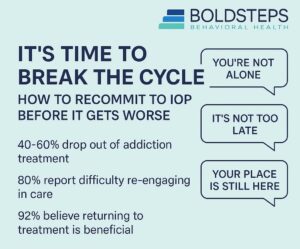
Why Coming Back to IOP Can Be Even More Powerful
When you first started IOP, you were probably in survival mode. Maybe scared. Maybe unsure if you even needed help. Maybe going through the motions for someone else.
But if you’re coming back now, you’re doing it with more honesty. More clarity. That matters.
Returning to IOP after a pause doesn’t mean you failed. It means you’re learning to listen to yourself. That’s one of the most important recovery skills of all.
Real Talk from Someone Who Returned
“Leaving group felt like failing, and I carried that for months. But when I called back, the person who answered said, ‘We’re proud of you for reaching out again.’ That cracked something open. I showed up the next day. I haven’t missed since.”
— IOP Client, 2024
It’s not too late to rewrite your relationship with recovery. Even if you’ve walked away before.
Quick Tips for Recommitting to IOP
Rejoining doesn’t have to be dramatic. Here’s how to start:
- Call or email with a short message. You don’t need to explain everything.
- Ask about your options. Some people pick up where they left off; others restart fresh.
- Set one small goal. Like making it to the first session back—nothing more.
- Tell someone. A friend, a family member, your old therapist. Let someone hold you accountable.
- Expect some discomfort. It gets easier after the first session back.
Frequently Asked Questions About Rejoining IOP
Can I come back even if I ghosted?
Yes. Ghosting happens. Life gets messy. You are always welcome back at Bold Steps IOP in Concord, NH. No lectures, no guilt trips.
Do I need to re-do the intake process?
Maybe. It depends on how long it’s been since you left and what’s changed. But don’t worry—it’s a conversation, not a test.
What if I’m using again?
That doesn’t disqualify you. In fact, it’s a sign you may need support even more. We’ll help you assess what level of care fits best right now.
Will my group judge me for leaving?
Not likely. Most people in IOP understand the ups and downs of healing. Many have left and come back themselves. You might be surprised how supported you feel.
Is there a deadline to return?
Nope. The door doesn’t close. Whether it’s been two weeks or six months, you can reach out anytime.
You’re Still Welcome at Bold Steps
It doesn’t matter how many times you’ve left, paused, restarted, or ghosted.
What matters is that you’re thinking about returning—and that means you still care. We care too.
Ready to take the next step?
Call (603) 915-4223 or visit our IOP services page to learn more about how we support re-entry, reconnection, and your next right step in Concord, NH. For those in Rockingham, Merrimack, Hillsborough, or Essex County, our nearby locations ensure care is always within reach.