

You didn’t plan to vanish. Maybe it started with a missed group. Then a skipped call. Then you told yourself, “I just need a break.” But here you are—two weeks, four weeks, three months out—and every day you don’t go back, the harder it feels to imagine doing it.
Let’s be real: you’re not the only one who ghosted their Intensive Outpatient Program (IOP). At Bold Steps New Hampshire, we see this all the time. And we want you to know something that matters: you’re still allowed back in. This wasn’t a failure. It was a pause. And you can hit “un-pause” today.
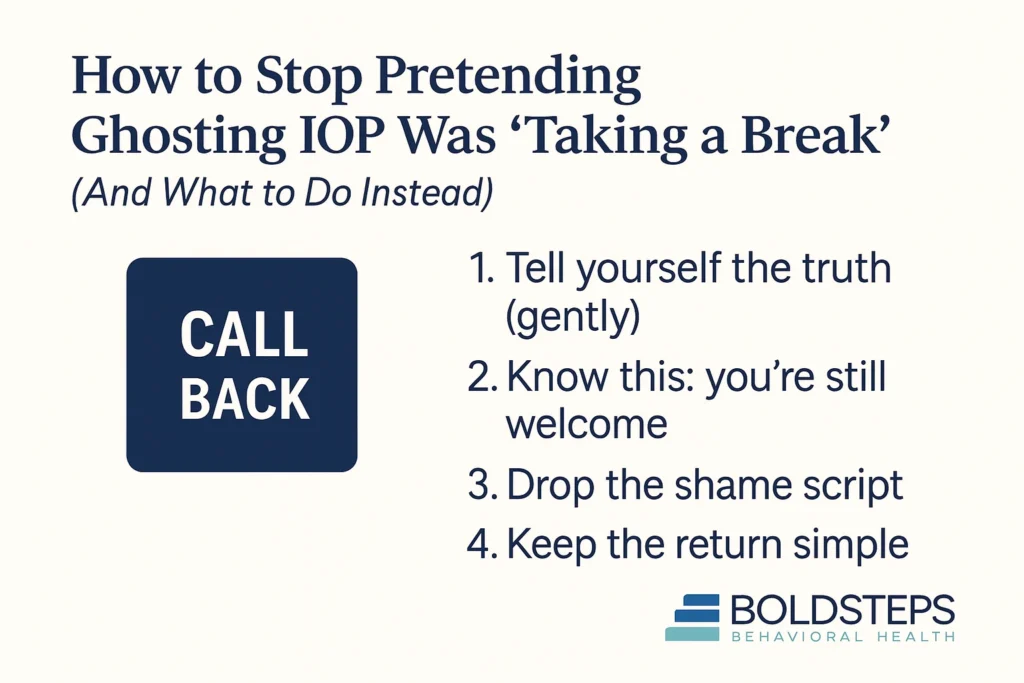
Step 1: Tell Yourself the Truth (Gently)
There’s no shame in telling yourself: “I stopped showing up.”
Not “I got too busy.”
Not “I wasn’t sure it was helping.”
Not “I just needed space.”
Those might all be parts of the truth—but the full truth is this: something pulled you away, and instead of naming it, you slipped out the back door and hoped no one would notice.
Guess what? That’s human. Avoidance is a survival tool. When shame or stress gets too high, disappearing can feel safer than facing what’s hard.
But here’s the reframe: avoidance isn’t failure. It’s just unprocessed fear. Telling the truth (to yourself first) is the first way out.
Step 2: What Really Made You Ghost?
The surface-level answer might be, “I was tired,” or “I hated group.” But usually, there’s a deeper story under that.
Ask yourself:
- Did group feel too vulnerable?
- Did you start slipping in other ways—drinking more, skipping meds, isolating again?
- Did someone say something that triggered old stuff?
- Did it just feel easier to disappear than explain?
You don’t need to fix these things yet. Just name them. Think of it as gathering intel. Every dropout has roots—and if you know yours, you can plan around them.
Step 3: Know This: You’re Still Welcome at Bold Steps
This one’s simple, but it’s where most people get stuck: you are not banned.
There’s a fear that floats around after ghosting:
“They probably think I’m a lost cause.”
“I messed up too bad.”
“They’re going to give me a lecture.”
Let’s bust that myth right now. At Bold Steps, we’ve had people return after two days and people return after two years. And when they do, we don’t grill them. We don’t shame them. We say: “We’re glad you’re back.”
Your chair is still there. Your name is still in the system. We never deleted your number. Come back as you are.
Step 4: Drop the Shame Script
Shame says:
“You blew it.”
“You never finish anything.”
“They won’t take you seriously now.”
Truth says:
“You got overwhelmed.”
“You made it this far, even with all the chaos.”
“You’re allowed to try again.”
Ghosting IOP isn’t a moral failure. It’s usually the symptom of something deeper—burnout, doubt, fear, a hidden spiral. But guess what? IOP is exactly the place to process that stuff.
You don’t have to show up with your shame story rehearsed. You can just say: “I’d like to come back.” That’s enough.
Step 5: Keep the Return Simple
You don’t need to write an apology essay. You don’t need to overexplain or make promises you’re scared you can’t keep.
All you need to do is call. Text. Email. Walk in.
Here’s what a return message can sound like:
“Hey, I know I disappeared for a while. I’m thinking about coming back. Is that okay?”
Yes, it’s okay. Yes, we’ll walk you through it.
Step 6: Make It Work for the You That Exists Now
The version of you who started IOP might not be the version of you right now. That’s fine.
When you come back, we can talk about:
- Adjusting your schedule
- Getting extra 1:1 support
- Changing tracks or groups
- Making IOP part of a bigger support plan
Treatment isn’t one-size-fits-all. Your needs are allowed to change. Let’s build something sustainable—together.
Step 7: Reclaim Your Story From the Ghost Narrative
It’s tempting to say you “took a break.” But if you didn’t tell anyone, didn’t plan to come back, and felt low-key guilty the whole time… that’s ghosting.
And that’s okay. But now you get to choose a new ending.
Instead of: “I ghosted and never looked back.”
Try: “I ghosted, and then I came back with more honesty than I had before.”
That kind of return? That’s power. That’s recovery.
Real Talk: You Didn’t Ruin Anything
We’re not keeping a tally. You’re not “behind.” The doors are still open. And the fact that you’re even reading this blog means something is stirring. That “what if I went back?” feeling? Listen to it.
You don’t have to keep hiding behind a pretend break. You can call it what it was—and come home anyway.
FAQ: Ghosting IOP and Coming Back
Is it normal to ghost an IOP?
Unfortunately, yes—it happens more often than you’d think. Life gets messy. Shame builds. Avoidance kicks in. What matters most isn’t why you ghosted, but what you do now.
Will I get in trouble for leaving without notice?
Nope. At Bold Steps, we don’t “punish” people for disappearing. We understand that leaving treatment can be part of the process. We’re here to help you re-enter, not interrogate you.
Do I have to start over from day one?
Not necessarily. We’ll look at how long you were away and what’s going on now. Sometimes we can resume where you left off. Sometimes we adjust your plan. Either way, we meet you where you’re at.
What if I’m embarrassed to come back?
That’s totally normal. But try not to let that stop you. Every week, someone returns who thought they never could. We’ll treat you with kindness and care—no lectures, no shaming.
What if I’m using again?
You’re still welcome. In fact, that’s even more reason to reach out. IOP is a safe place to stabilize, regroup, and decide what kind of support you need next. No judgment. Just options.
How do I restart my IOP at Bold Steps?
Easy. Just call us at (603) 915-4223 or visit our Intensive Outpatient Program page. You don’t have to have the perfect plan. You just need to show up.
Ready to Stop Ghosting and Start Again?
You don’t have to keep calling it a break. You can call it what it was—and you can come back anyway. The doors at Bold Steps New Hampshire are still open. So is your chance to get the support you actually deserve.
Call (603) 915-4223 or learn more about our IOP in New Hampshire. And for those in Rockingham County, Merrimack County, Hillsborough County, or Essex County, we have nearby locations to make care accessible. We’ll meet you where you are. No judgment. Just next steps.