

I said treatment didn’t work.
And I believed it. Not just for a while—for years.
I’d done the therapy. I’d filled the prescriptions. I’d done what I was “supposed” to do. But the fog stayed. The thoughts stayed. The nothingness stayed.
So I gave up.
I said I was one of the “treatment-resistant” people. I wore that like a shield. Like an excuse. And yeah—sometimes it protected me. But mostly, it just kept me stuck.
And nearly killed me.
This blog isn’t a sales pitch. It’s what I wish someone had handed me when I was too proud, too tired, and too hollow to believe anything could help. Especially treatment.
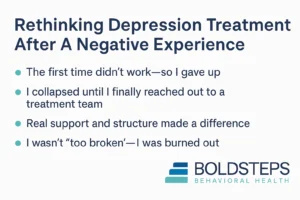
The First Time Didn’t Work—So I Quit
My first experience with treatment was…fine. I had a therapist. We talked. I got a script for an antidepressant. I stayed on it for two months. I didn’t feel “better,” so I stopped.
Then I told myself: See? Treatment’s a scam. You either tough it out or you don’t make it.
I truly believed that. And no one was arguing with me. People backed off. I looked functional on the outside, so they assumed I was okay.
But I wasn’t. I was just quietly drowning. And every time I tried to speak up, I talked myself out of it. “You’ve already tried. You know it doesn’t work.”
But what I’d done wasn’t really treatment. It was a half-step into the water before sprinting back to dry land.
The Collapse That Finally Shook Me
The breaking point wasn’t dramatic. I didn’t end up in a hospital. There was no suicide note.
Just one Thursday where I forgot how to care if I lived or died.
I lay in bed for 11 hours and watched the ceiling change color with the light. I didn’t eat. I ignored my phone. And for the first time, I understood how people just…slip away.
The only reason I reached out was because someone—a coworker I barely knew—texted me a number and said, “You don’t have to talk. Just show up.”
It was the depression treatment team at Bold Steps Behavioral Health in Concord, NH. And I didn’t believe it would work. I just didn’t want to be alone in the dark anymore.
What Real Depression Treatment Actually Looked Like
I expected cold walls. Shiny clipboards. People smiling too hard.
Instead, I got:
- A human voice saying, “We’re not here to fix you. Just walk with you.”
- Group sessions where I wasn’t the only one who’d “tried everything”
- Actual structure—a full program, not just a weekly therapy appointment
- Medication management—as in, real conversations about side effects, goals, and options
- Small wins celebrated without pressure to be “better” by next week
It wasn’t a miracle. It was maintenance. But I didn’t realize how starved I was for that.
I thought depression treatment was about becoming happy. It’s not. It’s about becoming functional again. Steady. Safe. Willing.
What Changed (And What Took Time)
The fog didn’t lift overnight.
But within three weeks:
- I had a reason to get dressed and leave the house
- I started eating actual meals again
- I went a whole day without obsessively googling “what’s the point of anything”
- I laughed—just once, but it felt real
By six weeks, I wasn’t thinking about disappearing. I was thinking about rebuilding.
And that scared me more than being numb. Because rebuilding means admitting you care again. And I hadn’t cared about myself in a long time.
But treatment gave me back a sense of agency. Not because they “fixed” me. But because they helped me remember how to participate in my own survival.
What Kept Me in the Room
I almost quit twice.
Once after a session that opened up stuff I’d buried for a decade. And once after a group where someone said exactly what I was afraid of—that maybe we’re all just managing this forever.
But I didn’t leave. Not because I believed it would work. But because someone else in the room said:
“You don’t need to believe in this today. Just don’t disappear today.”
That was enough.
If you’re reading this from Hillsborough County or somewhere nearby, and the idea of trying again makes your skin crawl—just know there are depression treatment options near you where you don’t have to smile, fake it, or explain everything.
I Wasn’t “Too Broken”—I Was Just Burned Out
For a long time, I thought I was uniquely untreatable. That I’d failed some invisible test and didn’t qualify for peace.
But the truth? I wasn’t too broken. I was too burned out to keep trying without support. And treatment is support. That’s it. No magical cure. No silver bullet. Just people and practices that help you hold the weight a little differently.
FAQs for People Who Think They’ve “Tried It All”
What if I’ve already done therapy and meds?
Most of us have. What you may not have done is structured, integrated treatment—like an IOP (intensive outpatient program), which includes daily support, group therapy, skill-building, and actual medication guidance.
Is treatment just another thing to fail at?
No. Treatment isn’t a test. There’s no passing or failing. There’s just showing up—even messy. Especially messy.
What if I don’t trust therapists anymore?
Totally fair. Not every therapist is a good fit. Good treatment programs, like the ones at Bold Steps New Hampshire, actually help match you with someone who gets it. You’re allowed to ask for that.
What if I don’t have the energy to try again?
That’s the depression talking—and it’s valid. But treatment isn’t about effort. It’s about structure that holds you until you can hold yourself again.
What if I hate group therapy?
Most people do at first. But many of us are surprised at how helpful it feels to stop pretending, even just once. You don’t have to share until you’re ready.
What makes Bold Steps different?
They don’t treat you like a checkbox. They don’t expect smiles. They start with honesty. And they build from there. If you’re in Rockingham County, you can reach their team here.
If You’re Still on the Fence, I Get It
You don’t have to believe this will change your life.
You just have to want things to stop hurting this much. That’s where I was. That was enough to make the call.
Bold Steps didn’t make my life perfect. But it kept me alive long enough to realize I still wanted one.
Call (603)915-4223 or visit Bold Steps Depression Treatment to talk to someone who won’t ask you to be okay—they’ll just ask you to show up.
That’s how it started for me. Maybe it starts there for you, too.