

You love them. You watch them. You worry.
Maybe they’re 19 or 22. Maybe they’re in college or sleeping on your couch. Maybe they’re trying—but you can see the light dimming behind their eyes. You offer support. Suggestions. A soft place to land. But nothing seems to reach them.
This blog isn’t written from a clinical voice. It’s written from a parent who’s been where you are—terrified, heartbroken, and unsure what comes next.
This is what depression treatment looked like from the other side.
When It’s More Than Just a “Rough Patch”
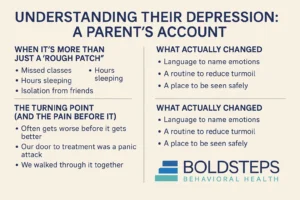
There were signs. Missed classes. Long hours sleeping. No appetite, or eating constantly. Isolation from friends. Snapping at the smallest things.
At first, I did what so many parents do: I gave it space. I didn’t want to overreact. Young adulthood is messy. Transitions are hard. But after months of false starts and emotional shutdowns, I realized something deeper was going on.
What I once hoped was a phase had settled into something heavier: a fog my child couldn’t shake. That’s when I started researching depression treatment.
The Turning Point (and the Pain Before It)
Here’s the part most people don’t talk about: things usually get worse before they get better.
In our case, it took a breakdown—a panic attack at work and a call home—to finally open the door to something more structured. Not because they wanted treatment, but because they were scared. And tired. And out of ideas.
That’s what treatment often is for young adults. Not some big moment of “I’m ready to change,” but a flicker of willingness. The tiniest crack in the wall.
We walked through that crack together.
What Depression Treatment Really Looked Like (Up Close)
I thought “treatment” meant a hospital. A locked facility. Something dramatic. What it actually looked like—especially at a place like Bold Steps New Hampshire—was much more grounded:
- A consistent schedule. For a kid who hadn’t had one in months.
- Group therapy. Where they saw they weren’t alone, or broken.
- Medication support. Managed by someone who didn’t just prescribe and walk away.
- Real-life coping skills. Things they could actually use outside the building.
And yes—there were hard days. Days they didn’t want to go. Days they said it wasn’t helping. But something was happening. Slowly, but surely, something was shifting.
What Helped My Child Engage (That I Didn’t Expect)
Here’s what didn’t work: nagging, hovering, or trying to “fix” their depression.
Here’s what did:
- Letting the professionals hold the structure so I could just be Mom again.
- Letting my child show up messy, confused, and imperfect.
- Trusting that healing doesn’t look linear—and doesn’t need to.
At Bold Steps, they weren’t treated like a problem to solve. They were treated like a person worth showing up for. That mattered more than I can say.
What Helped Me as a Parent (Also That I Didn’t Expect)
You’re told to be strong. Supportive. Available. But no one talks about how suffocating that can feel when your child is in crisis and you’re quietly falling apart.
Treatment helped me, too. Not because I was in the room every day—but because I finally had space to breathe. To grieve. To talk to someone who could say, “You’re not crazy. You’re not broken. You’re doing your best.”
That release gave me the strength to show up again—this time with more steadiness and less desperation.
If you’re a parent near Merrimack County, depression treatment services in your area can support your whole family, not just your child.
What Actually Changed (And What Didn’t)
Let me be honest: treatment didn’t make my child “happy.” It didn’t erase their depression.
But it did do this:
- It gave them language to name what they were feeling.
- It gave them a routine that made their world feel less chaotic.
- It gave them a place to be seen without judgment.
They still have hard days. But now, they know what to do with those days. They don’t fall as far. And when they do, they don’t fall alone.
What I’d Tell You, Parent to Parent
You’re probably wondering if it’s too soon—or too late—to consider depression treatment. Here’s what I’d say:
If your child is barely getting through the day, if they’re isolating, irritable, exhausted, or hopeless—it’s enough. You don’t have to wait for a crisis to offer them something more.
And if they resist the idea, that’s okay. Many young adults do. But if you can get them through the door—even skeptically—that’s where change can begin.
If you’re searching for depression treatment in Rockingham County, NH, Bold Steps is here to walk with you both.
What Hope Feels Like (Now That I Know)
Hope didn’t come to me as a big moment. It came in quiet ones.
- The day my child asked how I was doing.
- The day they laughed—genuinely—for the first time in weeks.
- The day they texted me a photo of their planner and said, “I think this helps.”
It didn’t fix everything. But it showed me we weren’t stuck forever. And that’s everything.
FAQs: What Parents Need to Know About Depression Treatment
How do I know if it’s time to consider treatment?
If your child is showing signs of emotional withdrawal, hopelessness, or an inability to function in daily life—treatment is worth exploring. You don’t need a formal diagnosis to start a conversation.
What if my child doesn’t want to go?
That’s incredibly common. Many young adults enter treatment reluctantly. It’s more important that they show up than that they feel “ready.” Willingness often grows over time.
What’s the difference between therapy and treatment?
Therapy is typically once a week. Depression treatment programs like those at Bold Steps offer multiple sessions per week, group support, medication management, and daily structure.
Can I be involved in their treatment?
Yes, where appropriate and with your child’s consent. Bold Steps offers family involvement opportunities, education, and communication so you’re not left in the dark.
What happens after treatment ends?
Many programs provide aftercare planning to help with ongoing support—whether that’s continued therapy, medication management, or support groups. Treatment is a beginning, not a finish line.
What if we’ve tried before and it didn’t work?
That doesn’t mean it can’t work now. Timing, approach, and emotional readiness all impact how effective treatment is. Every round of care is a chance to try differently—not harder.
You’re Still a Good Parent. Even If You’re Tired.
If your child is struggling with depression and you’re still trying to help them—you haven’t failed. You are loving someone through the most invisible kind of suffering. That takes strength.
And if you’re at the end of your rope, please know this: you don’t have to do this alone anymore.
Call (603)915-4223 or visit Bold Steps Depression Treatment to learn more about our services in Concord, NH. Hope may feel far away—but it’s still reachable. And we’re here when you’re ready.