

Even if you’ve committed to getting sober, it can still feel like you’ve stepped out of your life and into some alternate universe. Especially if you’re young. Especially if everyone around you still drinks like it’s no big deal. That “weird one” feeling? It’s valid.
But what if there’s a space designed not just to support your recovery—but to make sobriety actually make sense? That’s the heart of a Partial Hospitalization Program (PHP) like the one we offer here at Bold Steps Behavioral Health in Concord, NH. It’s not a lecture. It’s not a punishment. It’s a structured, real-life place to build skills, stability, and self-worth.
And it’s where a lot of people start feeling not so weird anymore.
1. It’s Normal to Feel Out of Place
The first few days in PHP can feel like walking into a room where everyone already knows the rules—except you. But here’s the thing: most people feel that way. Every group starts with strangers. Every circle has a first time someone speaks.
One young client put it this way:
“I thought I’d be the only one here who didn’t ‘get it.’ But everyone felt just as nervous—and weird—as I did.”
Naming that discomfort is often the first sign that you belong more than you think.
2. Small Wins Are Real Wins
In early recovery, you might feel like nothing you do is enough. PHP helps rewire that thinking. You learn to count the things you did do—like getting out of bed, showing up, sharing something honest.
Therapists here help you track those moments, not because they’re grading you—but because that’s where the progress is. Sobriety isn’t a straight line. But it is a series of choices, and even the smallest ones deserve credit.
3. Cravings Don’t Mean You’re Failing
Cravings aren’t something to be ashamed of. In PHP, we talk about them directly—what they feel like, what they mean, and how to manage them without judgment.
You’ll learn how to observe cravings like a weather system. They pass. You can ride them out without acting on them. That distance between urge and action? It’s something you get better at, and it’s a game changer.
4. You’re Not the Only One Who Feels Socially Weird
One of the most common concerns in young sobriety is, “How do I hang out with people now?” PHP doesn’t throw you into fake social scenarios. But the honesty in group therapy and shared meals builds a new kind of social muscle—one that doesn’t rely on alcohol or substances to feel connected.
When you hear someone say, “I went to my first party sober and left early on purpose. Still a win,” it makes space for you to define success on your own terms.
5. Coping Skills Aren’t Just Buzzwords
The word “coping skills” gets thrown around a lot—but PHP actually teaches you how to use them. You’ll learn which grounding exercises work for your body, how to spot your stress triggers, and how to build your own mental health toolkit.
You’ll probably try things that feel silly at first. Then one day, in the middle of a bad moment, you’ll realize you just used one—without thinking about it. That’s real growth.
6. Being Honest is Less Scary Than Pretending
In PHP, honesty is currency. You’ll see what happens when someone shares something real—something painful, even—and the group responds with understanding instead of judgment. It doesn’t just help them. It helps you too.
Pretending you’re fine is exhausting. Getting to drop the act—even once a day—can be the relief you didn’t know you needed.
7. Routine is Underrated
When you’re newly sober, your time might feel like an overwhelming blank space. No more late nights, no more substance-focused plans—so now what?
PHP fills that space with structure. Not in a rigid way, but in a stabilizing way. Therapy sessions, group check-ins, lunch, mindfulness—all anchored around a schedule that helps your nervous system settle. You start to see how predictable days make healing possible.
8. Connection Doesn’t Require a Buzz
Early sobriety can feel emotionally flat. It’s normal to wonder if you’ll ever laugh the same way again. But connection doesn’t die when substances go away—it just takes different paths.
You’ll hear people in PHP laugh at inside jokes, cry at shared stories, and root for each other’s progress. Real connection isn’t about being the funniest person at the party. It’s about being seen—and seeing others.
9. Big Feelings Aren’t Going to Break You
Without substances to numb out, emotions hit harder. That can be terrifying. But in PHP, you’re not facing those waves alone. You’ll learn how to ride them without getting swept under.
Therapists will help you map your emotional patterns, learn regulation tools, and name what used to feel like chaos. Feeling everything doesn’t mean you’re doing it wrong. It usually means you’re finally doing it.
10. You’re Not the “Weird One” for Wanting Something Different
Here’s the truth: most young people aren’t thinking about sobriety. But the ones who are? They’re often the ones paying closer attention to what actually matters.
Choosing mental health, stability, and self-respect in a culture that glamorizes numbing out isn’t weird—it’s gutsy. PHP helps reframe your choice as something powerful, not shameful. You start to see yourself less as the outsider and more as someone building a life with intention.
FAQ: Partial Hospitalization Program (PHP) in Concord, NH
What is PHP, exactly?
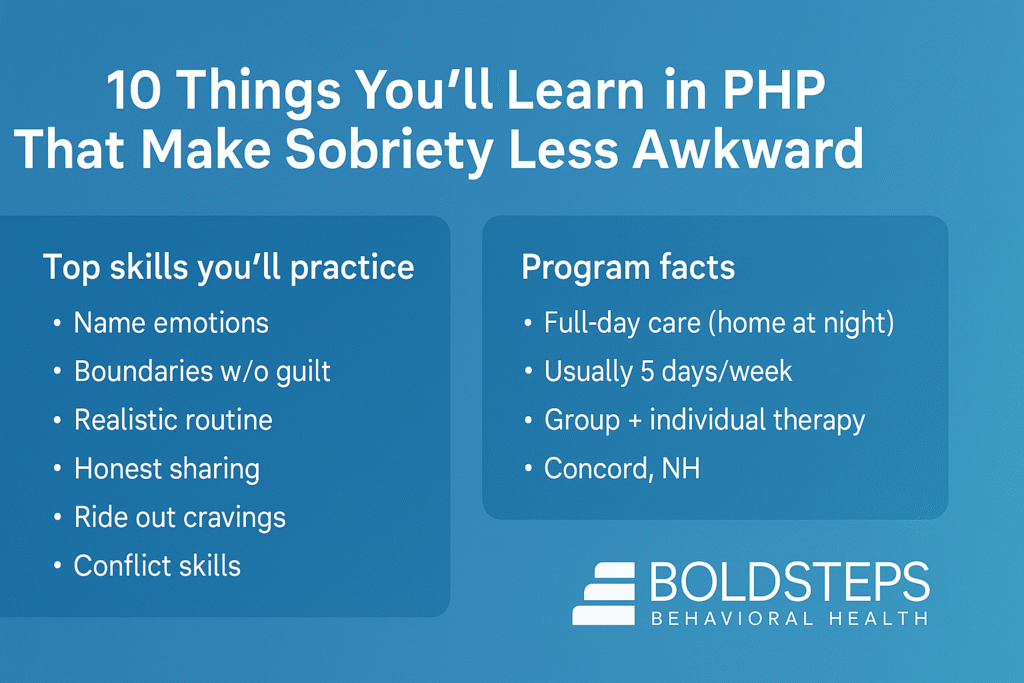
PHP stands for Partial Hospitalization Program. It’s a structured day treatment program for people who need more support than outpatient therapy, but don’t require 24/7 inpatient care. At Bold Steps, PHP typically runs five days a week and includes group therapy, individual therapy, psychiatric care, and skill-building.
Is PHP only for people with addiction?
No. Many people attend PHP for mental health concerns like anxiety, depression, trauma, or emotional dysregulation. It’s a supportive space for anyone who needs help stabilizing and building skills.
Can young adults join the program?
Absolutely. While PHP is open to adults of all ages, many young adults in Concord and surrounding areas join because they’re looking for a place that meets them where they are—without lectures or pressure.
Will I have to talk in group therapy?
You won’t be forced to share—but you’ll likely find it gets easier with time. Most people start slow. The group format is supportive and respectful, and everything shared is confidential.
How do I know if PHP is right for me?
If you’re feeling overwhelmed, emotionally unstable, or like you need more than a weekly therapy session to feel okay—PHP might be a great fit. It’s especially helpful if you’re newly sober or managing big emotional shifts.
Let’s Make Sobriety Feel More Like You
You don’t have to fake being fine or explain why you’re not drinking to people who don’t get it. In PHP, you’ll be surrounded by others doing the hard, human work of healing—and we’ll be with you every step.
Call (603)915-4223 or visit our Concord PHP services page, Rockingham County, Merrimack County, Hillsborough County, or Essex County, to learn how Bold Steps Behavioral Health can help you feel more at home in your own recovery.