

When your child is in crisis, everything feels urgent—and unclear.
Maybe you’ve noticed their moods swinging wildly. Maybe they’re isolating, missing class, or you’ve found evidence of drug or alcohol use. Or maybe something has already happened—a phone call, an arrest, a hospital visit—and now you’re staring down a decision you never imagined you’d have to make:
What kind of addiction treatment do they need—and how do I make the right call?
At Bold Steps Behavioral Health in Concord, New Hampshire, we support parents and caregivers facing this exact question every day. One of the most common crossroads families hit is deciding between residential treatment and outpatient care.
Here’s the honest breakdown—so you can choose based on your child’s needs, not just fear.
What’s the Difference Between Residential and Outpatient Addiction Treatment?
Let’s start with the basics.
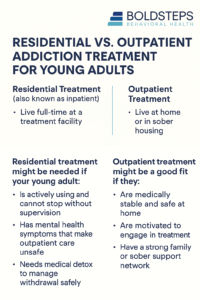
Residential treatment (also known as inpatient treatment) means your young adult lives full-time at a treatment facility. It’s immersive, 24/7 care, often including detox, therapy, medication management, and life-skills support. Residential treatment removes someone from their current environment so they can stabilize and start healing without outside triggers.
For families exploring addiction treatment in New Hampshire, residential care offers a highly structured environment ideal for intensive recovery work.
Outpatient treatment allows them to live at home or in a sober living setting while attending treatment during the day or evening. It includes therapy, groups, and medication support—but with more flexibility and personal responsibility.
At Bold Steps, both options are available, and many clients transition from one to the other as their needs evolve.
Residential Treatment: What It Offers and When It’s Needed
Residential treatment can feel like a big step—but for some, it’s the safest place to start. It might be the right fit if your young adult:
- Is actively using and cannot stop without supervision
- Has mental health symptoms (like suicidal ideation or psychosis) that make outpatient care unsafe
- Has already tried outpatient and relapsed
- Needs medical detox to manage withdrawal safely
- Is in an unsafe or triggering home environment
In a residential program, clients receive:
- 24/7 supervision and support
- Medical care, including detox if needed
- Intensive therapy (individual and group)
- A structured daily schedule
- A complete break from the people, places, and habits fueling substance use
It’s not about punishment. It’s about containment. A pause button. A protected space to start over—especially when every part of daily life feels like too much.
Outpatient Treatment: A Flexible and Powerful Alternative
Outpatient care can be a powerful—and appropriate—option for many families, especially when:
- Your child is medically stable and safe at home
- They’re motivated to engage in treatment
- They’re stepping down from residential care
- There’s a strong family or sober support network
- They’re managing school, work, or family obligations
At Bold Steps, our outpatient addiction treatment includes:
- Partial Hospitalization Program (PHP): A full-day structured program (usually 5 days/week) for people needing daily support without overnight care.
- Intensive Outpatient Program (IOP): A step down from PHP, offering 9–12 hours of care per week with added flexibility.
- Individual therapy, group therapy, and medication support tailored to each person’s recovery needs.
Outpatient care helps young adults build recovery in the context of their actual life. They learn how to stay sober while navigating real-world triggers, relationships, and responsibilities—with strong support every step of the way.
How to Compare: Residential vs. Outpatient at a Glance
| Category | Residential Treatment | Outpatient Treatment |
|---|---|---|
| Living Arrangements | 24/7 at a treatment facility | Lives at home or in sober housing |
| Supervision | Continuous monitoring | Scheduled check-ins and therapy |
| Ideal For | Severe addiction, mental health crises | Moderate symptoms, step-down care |
| Flexibility | Low | Moderate to high |
| Program Length | 30–90 days typically | Varies: from weeks to several months |
| Cost & Coverage | Higher cost; insurance often applies | Lower cost; also covered by many plans |
| Family Involvement | Limited during program | Encouraged and often included |
| Transition Opportunities | Often transitions to outpatient after | Can transition to individual therapy or peer support |
There’s no one-size-fits-all. But when we walk parents through this chart, it helps clarify: Where are they now—and what’s actually possible?
Still Unsure? Let’s Talk About Your Family’s Real Life
We know every family comes with its own dynamics, stressors, and limitations. You may be:
- Caring for other children
- Dealing with job constraints
- Struggling to convince your child they need help
- Exhausted from years of trying to “hold it together”
You are not alone in this. At Bold Steps, we offer family consultations where we listen—without judgment—and help you figure out what’s actually doable, effective, and appropriate.
The goal isn’t to find the perfect plan. The goal is to get them safely into motion—before things spiral further.
Even a single day of stability can open the door to long-term healing. We can help you get there.
FAQ: Addiction Treatment for Young Adults in New Hampshire
How do I know if my child needs treatment?
If substance use is impacting school, relationships, mental health, or safety—and your gut says something’s wrong—trust that. A free assessment can help clarify next steps.
What if they refuse to go?
You’re not powerless. We can help you build a strategy to engage your child in care, even if they’re hesitant or resistant. Family involvement can be the bridge.
Is detox always required before treatment?
Not always. It depends on what substances they’re using, how often, and their physical state. Our clinical team will assess whether detox is needed first.
Can we start with outpatient and move to residential later?
Yes. Many clients begin with outpatient and shift levels depending on their needs. We monitor progress closely and adjust treatment plans as needed.
What if we tried this before and it didn’t work?
That doesn’t mean they failed—or that you did. Sometimes, a new approach, provider, or setting makes all the difference. Recovery is rarely linear.
Take the First Step—You Don’t Have to Know Everything Yet
You don’t have to wait for rock bottom. You don’t need all the answers. You just need one phone call—and we’ll meet you where you are.
Call (603) 915-4223 or contact us to explore your options.
We’ll walk through the levels of care, the logistics, the fears—and help you move from overwhelmed to informed. Because your child’s recovery starts with your courage.