

If you’re reading this, there’s a good chance you’ve spent time arguing with your own mind.
Maybe you’ve decided to drink less.
Maybe you’re questioning your relationship with alcohol.
Maybe you’re simply trying to feel better emotionally.
And yet every time you take a step forward, a familiar voice seems to pull you backward.
“You’ll never stick with this.”
“You’re just going to fail again.”
“Other people can change. You can’t.”
“What’s the point?”
For many people who are sober curious, these thoughts can feel more discouraging than the behavior they’re trying to change.
The challenge isn’t simply making different choices.
The challenge is dealing with the running commentary inside your head.
At Bold Steps Behavioral Health NH, many people discover that meaningful change begins when they stop treating every thought like a fact. Learning practical skills through approaches like cognitive behavioral therapy can help people understand how thoughts influence emotions, behaviors, and decisions.
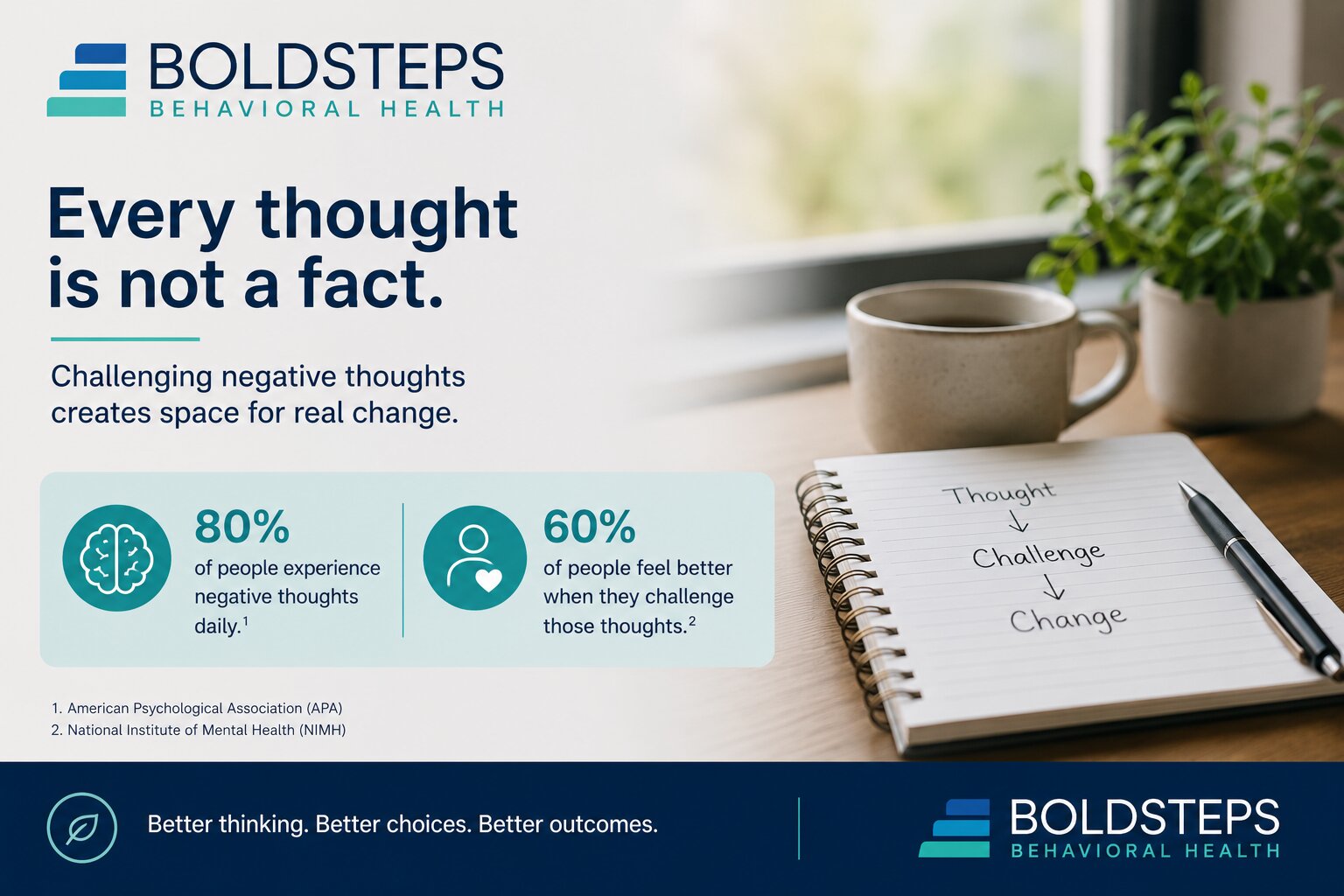
The good news is that negative thoughts can be challenged.
Not ignored.
Not suppressed.
Challenged.
And one of the simplest ways to do that is through a structured writing exercise.
If you’ve been searching for a printable way to work through difficult thoughts, this guide will walk you through the process step by step.
Why Your Brain Automatically Focuses on the Negative
Many people assume negative thinking means something is wrong with them.
In reality, the human brain is designed to detect problems.
Thousands of years ago, this helped people survive.
Paying attention to danger increased the chances of staying alive.
The problem is that modern life often activates that same survival system even when no physical threat exists.
A difficult conversation feels catastrophic.
A mistake at work feels permanent.
A setback in recovery feels like failure.
The brain becomes extremely skilled at spotting evidence that supports fear while overlooking evidence that supports hope.
This creates a distorted picture of reality.
Imagine looking into a mirror that slightly bends every reflection.
After enough time, you might forget the mirror is distorted and assume that’s what you actually look like.
Negative thinking often works the same way.
The goal of challenging thoughts isn’t to force optimism.
The goal is to see yourself and your situation more accurately.
The Hidden Cost of Unchallenged Thoughts
Many people underestimate how much influence thoughts have over daily life.
Consider this example:
A person decides not to drink for a weekend.
Later that evening, they think:
“I won’t be able to do this.”
That thought creates anxiety.
The anxiety creates discomfort.
The discomfort creates cravings.
Eventually they drink.
The next day they think:
“See? I knew I couldn’t do it.”
The original thought now feels proven.
But the thought wasn’t a prediction.
It was part of the process that contributed to the outcome.
This cycle happens constantly.
Thoughts influence feelings.
Feelings influence behavior.
Behavior reinforces beliefs.
The cycle repeats.
Learning to interrupt that cycle can create opportunities for change that previously felt impossible.
Step 1: Capture the Thought Exactly as It Appears
The first step is surprisingly simple.
Write the thought down.
Not a cleaned-up version.
Not a socially acceptable version.
The actual thought.
Examples include:
- “I’m a failure.”
- “I’ll never change.”
- “Nobody understands me.”
- “I’ve already ruined everything.”
- “I always mess things up.”
- “I don’t deserve to feel better.”
Most people are shocked by how harsh their thoughts sound when they see them on paper.
Thoughts that seemed normal in their head suddenly sound incredibly critical.
That awareness alone can be powerful.
You cannot challenge something you haven’t identified.
Step 2: Describe What Was Happening Before the Thought Appeared
Negative thoughts rarely appear randomly.
Usually something triggers them.
Ask yourself:
- What was happening?
- Who was I with?
- What emotion was I feeling?
- What event occurred first?
For example:
Situation:
“I saw pictures of friends drinking at a party.”
Thought:
“I’m missing out.”
Emotion:
Loneliness.
Understanding the trigger helps you spot patterns.
You may discover that certain people, situations, times of day, or emotional states consistently activate specific thoughts.
Awareness creates choice.
Without awareness, patterns continue unnoticed.
Step 3: Identify the Emotion Attached to the Thought
Many people skip this step.
Don’t.
Thoughts and emotions work together.
A single thought can trigger powerful feelings.
Common emotions include:
- Anxiety
- Shame
- Guilt
- Fear
- Anger
- Sadness
- Hopelessness
- Loneliness
Rate the intensity from 0–100.
Example:
Emotion: Anxiety
Intensity: 85/100
This gives you a starting point.
Later, you can compare whether your emotional response changes after examining the thought more closely.
Step 4: Gather Evidence Supporting the Thought
This may feel uncomfortable.
Many people assume challenging thoughts means immediately replacing them with positive statements.
Instead, start by examining the evidence honestly.
Ask:
“What facts support this thought?”
Example:
Thought:
“I’ll never change.”
Supporting evidence:
- I’ve tried before.
- I’ve broken promises to myself.
- I’ve struggled for a long time.
Keep the list factual.
Avoid exaggeration.
Avoid emotional conclusions.
You’re collecting evidence, not attacking yourself.
Step 5: Gather Evidence That Challenges the Thought
This is often where the shift begins.
Ask:
“What evidence does not support this thought?”
For example:
- I’ve made progress before.
- I’ve successfully changed habits in other areas.
- I’ve gone periods without drinking.
- I’m actively seeking information.
- Many people need multiple attempts before lasting change occurs.
Negative thinking often acts like a prosecutor presenting only one side of the story.
This step invites the defense attorney into the room.
Both sides deserve to be heard.
Step 6: Create a Balanced Alternative Thought
Notice what this step does not say.
It does not say:
“Replace the thought with something positive.”
Your brain will reject statements that feel unrealistic.
Instead, create something balanced.
Original thought:
“I’ll never change.”
Balanced thought:
“Change has been difficult for me, but difficulty does not mean impossibility. Many people struggle before making lasting progress.”
Original thought:
“I always fail.”
Balanced thought:
“I’ve experienced setbacks, but I’ve also had successes. Neither defines me completely.”
Balanced thoughts feel believable.
Believable thoughts are more likely to create meaningful change.
A Printable Exercise You Can Use Anytime
Many people prefer a structured format.
You can create a simple worksheet using the following sections:
| Situation | Thought | Emotion | Evidence For | Evidence Against | Balanced Thought |
|---|---|---|---|---|---|
| What happened? | What did I think? | What did I feel? | Supporting facts | Contradicting facts | More balanced perspective |
This format slows the thinking process down.
Instead of automatically accepting a thought, you’re investigating it.
Many therapists use a similar structure because it encourages curiosity rather than self-judgment.
A thought challenging worksheet can be especially helpful when negative thinking feels overwhelming or repetitive.
Why This Exercise Matters for People Who Are Sober Curious
When people think about changing their relationship with alcohol, they often focus entirely on behavior.
Drink less.
Stop drinking.
Avoid certain situations.
While those goals matter, they are only part of the picture.
The thoughts surrounding alcohol often deserve attention too.
Examples include:
“I need alcohol to relax.”
“Everyone drinks this much.”
“I can’t enjoy myself without it.”
“I’m too stressed to stop.”
“I’ll never stick with it.”
When these thoughts go unchallenged, they quietly influence decisions.
Questioning them creates room for new possibilities.
Many people discover that changing behavior becomes easier when they also change the way they think about themselves and their circumstances.
What If the Same Thought Keeps Returning?
This is completely normal.
People often expect one worksheet to eliminate years of negative thinking.
Unfortunately, that’s not how the brain works.
Think of negative thoughts as well-worn paths through a forest.
Every time you walk the same path, it becomes easier to follow.
New paths take effort.
At first they feel awkward.
Over time they become more natural.
The goal is not to eliminate every negative thought.
The goal is to respond differently when those thoughts appear.
Progress often looks like:
“I still had the thought.”
Instead of:
“I never had the thought.”
That’s an important distinction.
When Additional Support Can Make a Difference
Self-help tools can be incredibly valuable.
Many people gain insight simply by slowing down and examining their thinking patterns.
But sometimes negative thoughts are connected to deeper issues.
Anxiety.
Depression.
Trauma.
Substance use.
Chronic stress.
When that happens, additional support may help uncover patterns that are difficult to recognize alone.
For individuals seeking help in Areas We Serve or exploring treatment options in Rockingham County NH, professional guidance can provide practical tools for understanding and changing long-standing thought patterns.
The Thought Is Not the Final Word
One of the most powerful realizations people experience is this:
A thought can feel true without actually being true.
Your mind may tell you that change is impossible.
It may tell you you’re stuck.
It may tell you you’ve already failed.
Those thoughts deserve examination—not automatic obedience.
Every time you question a negative belief, you create a small opening.
A little more perspective.
A little more flexibility.
A little more hope.
And sometimes that’s enough to help you take the next step.
Frequently Asked Questions
What is the purpose of a negative thought worksheet?
A worksheet helps slow down automatic thinking patterns and encourages you to examine whether a thought is fully accurate. It creates space between the thought and your reaction.
How often should I complete this exercise?
Many people use it whenever a strong negative thought appears. Others complete one worksheet daily to build awareness and practice healthier thinking habits.
Can this help with alcohol-related challenges?
Yes. Negative thinking often contributes to hopelessness, shame, and self-doubt. Challenging those thoughts can support healthier decision-making and increased confidence.
What if I still believe the negative thought afterward?
That’s okay. The goal is not to force yourself to believe something different immediately. The goal is to become more aware of alternative perspectives and reduce the thought’s influence over time.
Is it normal to feel emotional while doing this exercise?
Absolutely. Writing down painful thoughts can bring emotions to the surface. Many people experience sadness, relief, frustration, or insight during the process.
Does this exercise replace therapy?
No. While worksheets can be helpful tools, therapy provides individualized guidance and support. Many people benefit from using both together.
What if my thoughts feel too overwhelming to challenge?
If negative thoughts are significantly affecting your daily life, relationships, emotional well-being, or recovery goals, professional support may be beneficial. You do not have to work through everything alone.
Call 603-915-4223 or visit our therapy and CBT services to learn more about our therapy, cbt services in New Hampshire.