

He sat in his driveway for almost forty minutes before going inside.
The engine was off, but the dashboard still glowed faintly in the dark. His work bag sat untouched in the passenger seat. Three unread emails buzzed across his phone screen while a half-empty travel mug rested in the cupholder beside him.
From the outside, his life looked stable.
Good career.
Mortgage paid.
Kids asleep upstairs.
A calendar full of meetings and responsibilities.
Nobody looking at him would’ve guessed he had just spent the entire drive home bargaining with himself about whether he would drink again that night.
That’s the part people misunderstand about high-functioning drinking problems.
A lot of people are not falling apart publicly.
They’re slowly disappearing privately.
And many people exploring outpatient treatment options begin from exactly that place — exhausted, overwhelmed, still functioning, and deeply unsure whether they “deserve” help yet.
Most People Wait Longer Than They Needed To
Very few high-functioning people wake up one morning and suddenly decide:
“I need treatment.”
Usually it’s slower than that.
It starts with small negotiations:
- “I’ll only drink on weekends.”
- “I just need a stressful season at work to end.”
- “I’m not drinking that much.”
- “Other people have it worse.”
- “I can still handle my responsibilities.”
And for a while, those explanations feel believable.
Because technically, life may still be working.
That’s what makes this so confusing.
The person may still:
- Show up to work every day
- Hit deadlines
- Parent effectively
- Exercise regularly
- Socialize normally
- Look successful externally
Meanwhile internally:
- Anxiety keeps escalating
- Sleep worsens
- Emotional burnout deepens
- Drinking slowly increases
- Shame quietly grows
- The nervous system never fully relaxes
High-functioning people often become experts at carrying suffering invisibly.
Drinking Often Starts Feeling Less Like Fun and More Like Relief
This shift matters.
A lot.
Many people don’t initially seek help because alcohol is creating obvious destruction. They seek help because alcohol has quietly become their primary coping system.
Not for partying.
For surviving.
To shut the brain off after work.
To stop overthinking.
To tolerate stress.
To numb emotional exhaustion.
To sleep.
To socialize comfortably.
To finally feel calm for thirty minutes.
That transition can happen gradually enough that people normalize it for years.
Especially professionals, caregivers, parents, and high performers.
Because when life demands constant output, alcohol can start feeling less like recreation and more like an emotional pressure valve.
Until eventually the pressure starts building faster than the coping mechanism can manage.
“I Can’t Leave My Life for a Month” Stops Many People From Reaching Out
This is one of the most common fears we hear.
People assume treatment automatically means:
- Leaving work entirely
- Stepping away from family
- Disappearing from responsibilities
- Explaining everything publicly
- Pausing life completely
That fear alone keeps countless people stuck.
Especially high-functioning individuals who already feel emotionally responsible for everyone around them.
Some are supporting families financially.
Some are business owners.
Some are caregivers.
Some fear professional judgment.
Others simply cannot emotionally tolerate the idea of stepping fully outside their routines.
That’s why many begin searching quietly for alcohol help without rehab before they ever tell another person they’re struggling.
And honestly, that search is often deeply hopeful.
Because it means part of them still believes change might be possible without completely detonating their life first.
The Hardest Part Is Usually Admitting the Current Version of Life Isn’t Sustainable
Not admitting alcoholism.
Not admitting weakness.
Admitting exhaustion.
There’s a difference.
A lot of high-functioning clients are not in denial that something is wrong. They’re in conflict about whether they’re “allowed” to need support.
Because many have built identities around:
- Being dependable
- Being productive
- Being capable
- Being the stable one
- Being the helper
- Being the strong person in the room
Treatment threatens that identity emotionally.
Even exploring support can feel like failure.
We’ve worked with clients who looked incredibly successful externally while privately:
- Drinking every night
- Having panic attacks
- Feeling emotionally detached from loved ones
- Fantasizing about disappearing
- Operating on constant anxiety
- Barely sleeping
- Feeling numb almost all the time
Not because they lacked discipline.
Because they had been forcing themselves to survive without enough support for too long.
High-Functioning People Tend to Minimize Their Pain
This becomes part of the problem.
Many clients instinctively compare themselves to worse-case scenarios:
- “At least I still have my job.”
- “I’m not drinking in the morning.”
- “I’ve never gotten arrested.”
- “I’m still handling things.”
- “I’m not as bad as other people.”
But suffering is not a competition.
And functionality alone is a terrible measurement for emotional wellbeing.
Some people are functioning while their nervous system is essentially running a marathon every day internally.
Some are functioning while deeply depressed.
Some are functioning while emotionally disconnected from everyone they love.
Some are functioning while using alcohol to survive every evening.
Functioning can hide a tremendous amount of pain.
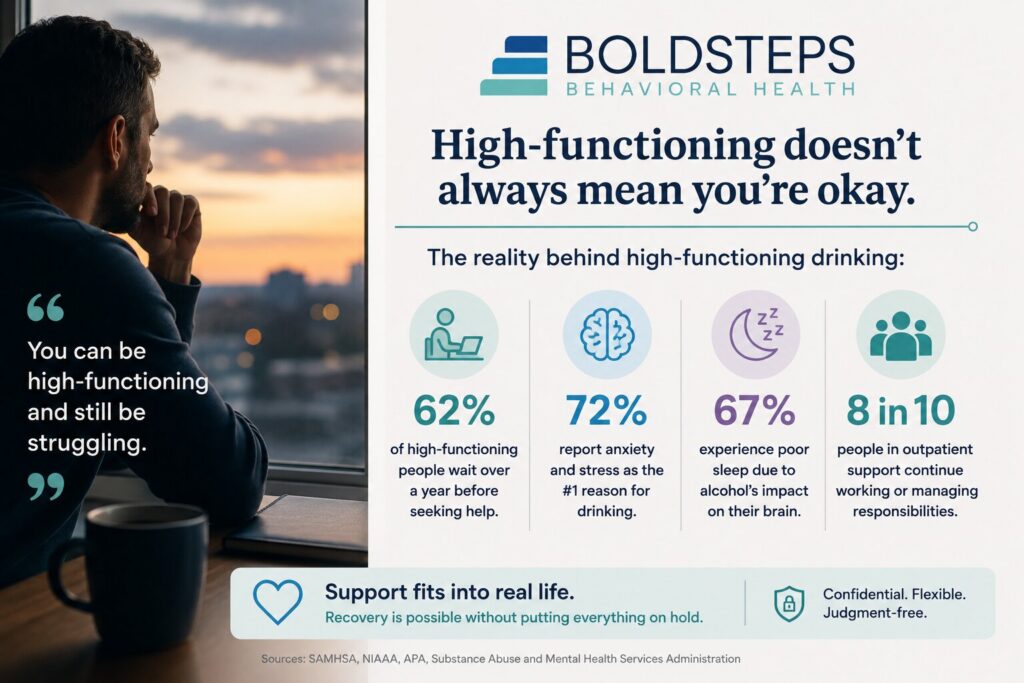
Getting Help Didn’t Look Like What He Expected
This surprises many people.
Treatment did not immediately mean disappearing from life forever.
For some clients, support begins through several therapeutic sessions weekly while maintaining work and home responsibilities.
Others temporarily need more structure, accountability, or emotional stabilization before stepping down into a more flexible schedule later.
The right level of care depends on:
- Emotional stability
- Drinking patterns
- Mental health symptoms
- Burnout severity
- Safety concerns
- Coping ability
- Home environment
- Ability to function outside treatment
Not simply how “successful” someone appears externally.
That distinction matters deeply because many high-functioning clients are suffering quietly behind polished routines and impressive résumés.
The First Emotion Many Clients Feel Is Relief
Not transformation.
Not immediate happiness.
Relief.
Relief from hiding.
Relief from constantly calculating drinking.
Relief from pretending things feel manageable.
Relief from carrying everything alone.
Relief from performing stability every second of the day.
Sometimes people don’t realize how exhausted they are until they stop trying so hard to appear okay.
One client described it this way:
“I thought treatment would feel humiliating. Honestly, it mostly felt like finally setting down a backpack I forgot I was carrying.”
That image stays with people because high-functioning suffering is often invisible even to the person experiencing it.
The pressure accumulates slowly.
The coping narrows slowly.
The isolation deepens slowly.
Until eventually life starts feeling emotionally claustrophobic.
Many People Aren’t Trying to Get Drunk — They’re Trying to Get Quiet
That distinction matters too.
A lot of high-functioning clients are not reckless people seeking chaos.
They’re exhausted people seeking relief.
Relief from:
- Constant mental noise
- Anxiety
- Emotional pressure
- Burnout
- Perfectionism
- Overthinking
- Responsibility fatigue
Alcohol temporarily creates silence.
The problem is that over time, the nervous system adapts. Relief becomes shorter. Dependence grows stronger. Emotional regulation weakens further.
And eventually, people realize the thing helping them cope is also quietly trapping them.
That realization can feel terrifying.
But it can also become a turning point.
The Goal Isn’t to Blow Up Your Life
This is where many people’s understanding of treatment changes.
Support is not about punishment.
It’s not about stripping people of identity.
It’s not about forcing shame or collapse.
For many people, treatment becomes about learning how to remain present inside their actual life again.
That may include:
- Building healthier coping skills
- Reducing dependence on alcohol
- Processing anxiety and burnout
- Learning emotional regulation
- Improving sleep
- Reconnecting with family
- Feeling emotionally available again
- Creating a life that feels sustainable
Not perfect.
Sustainable.
That word matters more than people realize.
Because many high-functioning clients have spent years surviving unsustainable lives while convincing themselves they were “fine.”
You Do Not Need to Hit Rock Bottom to Deserve Support
This may be the most important thing many people need to hear.
You do not need:
- Public collapse
- Catastrophic consequences
- Total dysfunction
- Complete life destruction
…before you are allowed to seek help.
Sometimes the clearest sign someone needs support is not chaos.
It’s chronic exhaustion.
It’s needing alcohol to finally exhale at the end of every day.
It’s realizing your nervous system never fully powers down anymore.
It’s feeling emotionally absent from your own life.
It’s quietly wondering how long you can realistically keep this pace up.
Those moments matter.
And sometimes the strongest sentence a person says is not:
“I ruined everything.”
It’s:
“I don’t want things to get worse before I take this seriously.”
That sentence changes lives.
FAQ: Getting Help While Still Managing Daily Life
Can I get help for drinking without leaving work completely?
In many cases, yes. Some treatment options allow people to continue working while receiving structured therapeutic support throughout the week.
What if I’m still functioning normally?
Many high-functioning people continue working, parenting, and maintaining responsibilities while privately struggling with alcohol use, anxiety, depression, or burnout. Functioning does not mean you aren’t suffering.
Does needing treatment mean I’m an alcoholic?
Not everyone seeking support identifies with that label immediately. Many people simply recognize that alcohol has become emotionally or psychologically unsustainable in their life.
What if I don’t think I’m “bad enough” yet?
This is extremely common. Many people delay support because they compare themselves to more visible or severe situations. But early intervention often prevents deeper emotional, physical, and relational consequences later.
Can treatment help if I mainly drink because of stress?
Yes. Many people use alcohol to manage stress, anxiety, emotional overload, burnout, or difficulty slowing down mentally. Treatment often focuses on building healthier coping strategies and emotional regulation skills.
Will people find out I’m getting help?
Privacy concerns are very common among professionals and high-functioning individuals. Treatment teams can often discuss scheduling, confidentiality, and practical concerns during the assessment process.
What’s the difference between outpatient support and live-in treatment?
Some people require round-the-clock support due to safety or stabilization needs. Others benefit from structured outpatient care that allows them to continue parts of daily life while receiving consistent therapeutic support.
Is it possible to recover without completely stepping away from life?
For many people, yes. Recovery does not always require disappearing from responsibilities entirely. The right level of support depends on the individual’s needs, symptoms, safety, and stability.
Call (603)915-4223 or visit our intensive outpatient program services to learn more about our intensive outpatient program services in Merrimack County, NH.