

You’re holding it together. Barely.
You’re showing up for work, taking care of the family, responding to texts (eventually), and keeping the world from seeing the cracks. From the outside, it looks like you’re managing. But inside, things feel off. Heavy. Maybe even unlivable.
If you’re reading this, you’re probably already considering—or enrolled in—an intensive outpatient program. And if you’re someone who’s used to powering through, here’s what you need to hear: IOP can’t be just another thing on your to-do list. It won’t work that way. In fact, treating it like a calendar item might be the very thing blocking your healing.
Let’s talk about why.
High-Functioning Is Not the Same as Healthy
Being high-functioning doesn’t mean you’re okay. It just means you’ve gotten really good at managing chaos without letting it spill over.
You’ve likely built a system around performance. You meet deadlines. You show up for other people. You’re productive, dependable, efficient. Maybe even admired.
But you’re also exhausted. Anxious. Secretly spiraling. Maybe you’re drinking more than you admit. Or relying on something else to keep your engine running.
The world rewards you for staying functional—but your body, mind, and soul are asking for something different.
IOP Isn’t Meant to Be Squeezed In
Here’s the common trap: you enroll in an IOP thinking, “I’ll fit this in after work,” or “I’ll knock this out three nights a week like a fitness class.” Sounds efficient, right?
Wrong.
An intensive outpatient program is not another productivity tool. It’s not therapy-lite. It’s not a side project. And if you approach it like one, you will almost certainly miss the point.
You can’t audit your own healing.
IOP demands more than attendance—it requires emotional availability. And the truth is, that might be more uncomfortable than you’re used to. But that discomfort? It’s where the change begins.
You’re Not There to Impress Anyone
High-functioning clients often fall into the pattern of treating therapy like a performance.
You come in with the right words. You check in quickly. You summarize your week like a report. You say what you think you’re supposed to say.
But that’s not real healing. That’s strategy.
IOP isn’t about sounding insightful—it’s about being real. Some days, that means saying “I have no idea what I’m feeling.” Other days, it means admitting you were irritable, distant, or afraid.
You don’t need to be polished. You need to be present.
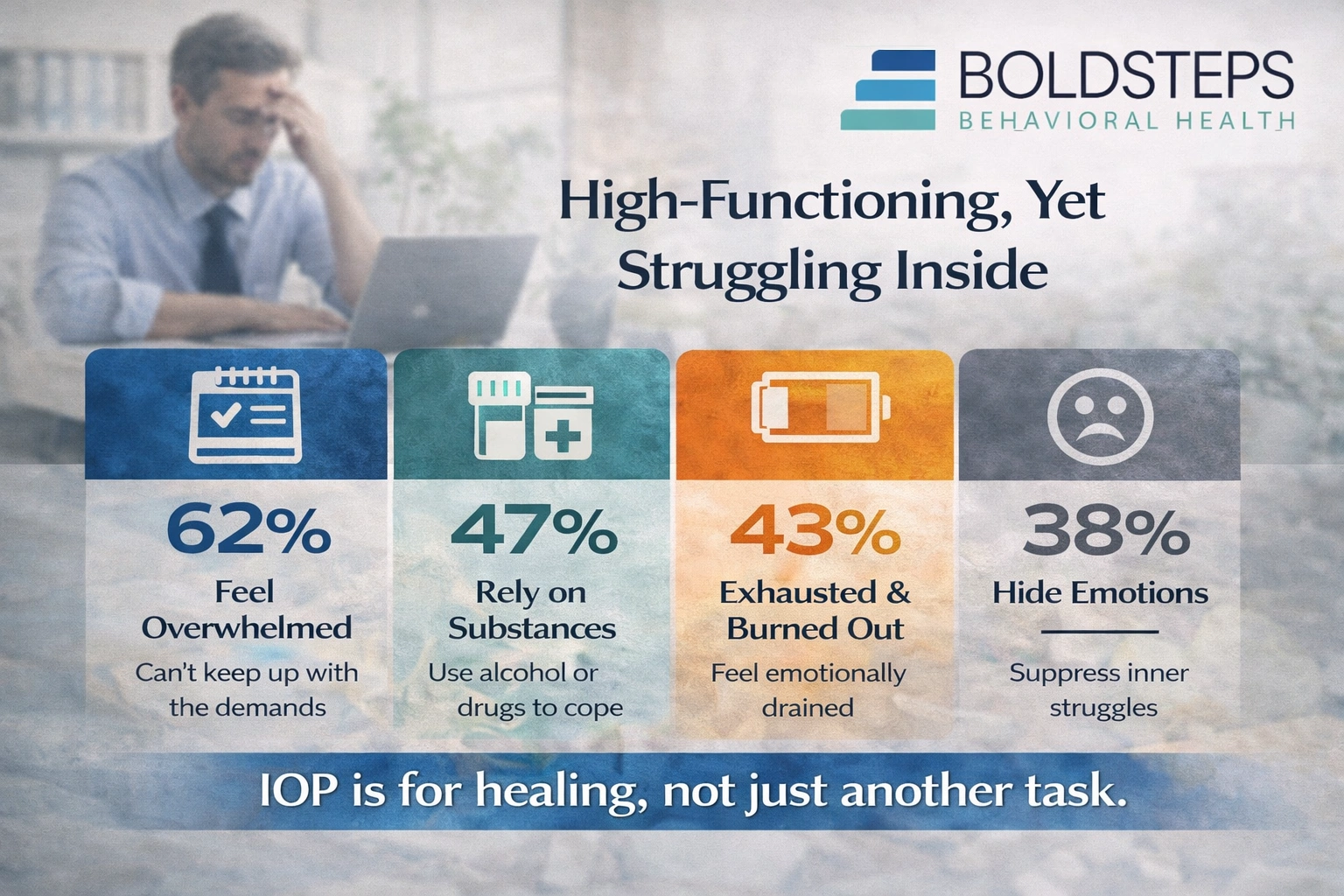
The Burnout You Don’t Talk About
Let’s name something out loud: you’re tired. Not just physically. Existentially.
You’re tired of pretending you’re fine. Tired of playing the role. Tired of spinning plates and smiling while everything inside you says, “I can’t keep this up.”
This isn’t failure. This is the toll of surviving too long in overdrive.
People assume if your life hasn’t fallen apart, then it must be working. But what about the slow unravel? The emotional isolation? The ache of carrying something no one else sees?
An IOP can offer a space to unload that weight—but not if you keep carrying the mask into the room.
You Need Space to Heal—Not Just Time
It’s easy to convince yourself that showing up three times a week means you’re doing the work. But healing isn’t just about time. It’s about space.
And emotional space doesn’t happen automatically when you enter the building. You need to mentally unplug from everything else long enough to feel. To sit with the hard stuff. To talk without editing. To feel without numbing.
That space might feel foreign. Even threatening. Especially if you’ve spent years compartmentalizing and pushing through.
But that’s also why IOP can be powerful—because it asks you to finally stop running.
Real Recovery Doesn’t Happen in the Margins
If your instinct is to build your day around productivity and then squeeze recovery into the leftover time, you’re not alone. It’s a classic high-functioning move.
But it doesn’t work.
Recovery isn’t dessert. It’s not optional. It’s not what you do after everything else is handled. It has to become the center, not the side dish.
That doesn’t mean quitting your job or dropping everything. It means acknowledging that if you’re serious about healing, it has to be prioritized. Not because you’re fragile—but because you’re worth it.
And if you live in Rockingham County, New Hampshire, or Merrimack County, New Hampshire, you deserve access to IOP support that meets you where you are—without judging how long you’ve been holding it all together.
Emotional Availability Beats Efficiency
You can’t spreadsheet your way out of this.
Many high-functioning professionals are wired to solve problems efficiently. But this isn’t a project you can “optimize.” Recovery is nonlinear, messy, and deeply human.
You’ll need to feel your way through things you’ve avoided for years. You’ll need to sit with shame, disappointment, grief—without trying to solve or outsmart them.
It’s hard. But it’s honest.
If You’re Not Ready to Be Real, That’s a Signal
One common red flag we see? Clients showing up, but staying detached. Participating, but guarded. Talking, but not really connecting.
It’s not a problem to feel resistant. But it is a signal.
If part of you doesn’t want to be there, or doesn’t think you belong, say that out loud. That’s real. That’s what we can work with. Pretending you’re fully engaged when you’re not? That’s where we lose traction.
You don’t need to be all in right away. But you do need to be honest about where you are.
The Risk of Wasting Your Own Time
IOP is a commitment—not just in terms of schedule, but emotionally. If you treat it like just another task, you risk wasting hours that could’ve actually helped you shift something big.
We’ve seen it happen: brilliant, capable people who show up but stay in performance mode. And months later, they wonder why nothing feels different.
You owe it to yourself to go deeper than that.
Even if it’s awkward. Even if it’s terrifying. Especially if it’s unfamiliar.
Frequently Asked Questions (FAQs)
What is an intensive outpatient program (IOP)?
An IOP is a structured mental health or addiction treatment program that allows you to receive high-level therapeutic support while continuing to live at home. At Bold Steps, our IOP includes group therapy, individual counseling, and skill-building, typically 3–5 days per week.
Is IOP right for high-functioning individuals?
Absolutely. Many high-functioning people assume they’re “not sick enough” for IOP—but that’s a myth. If you’re struggling with emotional burnout, substance use, or chronic dissatisfaction and want meaningful support, IOP could be a fit.
Can I work full-time while attending IOP?
Sometimes—but it depends. Many programs offer flexible scheduling, but what matters most is whether you have emotional capacity to actually engage. If you’re running from one commitment to the next without space to reflect or feel, it may be time to reassess priorities.
What if I’m not sure I belong in IOP?
That’s a common feeling—especially for people who haven’t hit “rock bottom.” But IOP isn’t reserved for crisis moments. It’s for anyone who wants to change patterns that aren’t working. If you’re exhausted, disconnected, or using something to cope, you belong.
Will people in the group understand me?
You might be surprised. High-functioning people often feel isolated because their pain is invisible. But in IOP, many participants come from professional, family, and leadership backgrounds. The shared experience isn’t in the details—it’s in the emotions underneath.
Here’s the Bottom Line
You don’t have to crash to course-correct.
You don’t have to wait until it all falls apart to ask for help. But if you step into an IOP and try to muscle through it the same way you’ve muscled through everything else, you’ll miss the point.
This is the space where you can finally stop performing. Where the pressure drops. Where honesty is more valuable than hustle.
You’re not weak for needing help. You’re strong enough to stop pretending you don’t.
Ready to talk? Call (603) 915-4223 or visit Bold Steps IOP to learn more about our intensive outpatient program in Concord, New Hampshire.