

You’ve built your world around feeling deeply. Maybe you’re the one who notices things others miss. The one who creates, performs, dreams, or connects in ways that can’t always be explained. Your emotions might be loud—sometimes overwhelming—but they’re also the source of your spark. And somewhere along the way, substances became part of how you accessed it. Or managed it. Or kept it from consuming you.
So when someone says, “Have you thought about getting help?”—your mind might go straight to panic.
“If I get sober… will I disappear?”
We hear you. And we want you to know: dual diagnosis treatment doesn’t strip away who you are. It helps you protect the parts of yourself that have always been real—the ones that make you you. Not in spite of your emotions, but in partnership with them.
Identity Fear Is More Than Ego—It’s Grief in Advance
You’re not being overdramatic. You’re being honest.
For people whose personalities are tightly woven with intensity—emotionally, creatively, socially—the fear of “losing yourself” in treatment is real. Not because you’re unwilling to grow, but because you’ve had to fight for your identity. You’ve had to make peace with the chaos, learn how to ride the waves instead of shutting down. And substances, as messy as they’ve become, may have felt like the key to unlocking that version of you.
So when someone suggests treatment, it can feel like they’re asking you to become someone else—someone less passionate, less fun, less real. But here’s the truth:
You don’t need to erase yourself to heal.
You need support that can handle your depth.
Dual diagnosis treatment at Bold Steps is built for that.
Your Emotions Are Not the Problem
Many of the people we work with describe themselves as “too much.” Too sensitive. Too intense. Too wired. Too raw.
What if we told you that none of that is a diagnosis?
High emotion isn’t a flaw—it’s often a gift that just hasn’t been cared for. And when that emotional reality collides with trauma, mental health conditions, or unstable environments, it makes sense that you’d need something to manage the volume. For some, that’s alcohol. For others, it’s cannabis, stimulants, or simply not sleeping.
But your core emotional sensitivity? Your insight? Your fire?
That’s not the symptom. That’s the soul.
Our dual diagnosis approach helps you separate what’s hurting you from what’s true about you—so you can keep your identity intact, without letting it burn you alive.
What “Stability” Doesn’t Mean—And What It Can
One of the most common fears we hear is this:
“I don’t want to be numbed out. I’d rather feel everything than feel nothing.”
And we get that. So many of our clients come in terrified that medication will flatten them, therapy will “normalize” them, or recovery will steal their spark. The fear isn’t about getting better—it’s about becoming unrecognizable in the process.
That’s why dual diagnosis care isn’t just about helping you “function.” It’s about helping you come alive with clarity—not chaos.
That might look like:
- Feeling your emotions in waves instead of tsunamis
- Creating with intention, not just pain
- Having energy that’s not borrowed from tomorrow
- Laughing without the crash
- Trusting your mind again
Stability isn’t blandness. It’s being able to stand still without splintering.
Real Clients, Real Fears—And What They Found
You’re not the only one thinking this way. We’ve seen clients who:
- Only painted when they were high
- Could only perform after drinking
- Felt more social, more confident, more “themselves” while using
They came to treatment afraid they’d lose all of it. But here’s what most discovered:
- Creativity didn’t disappear. It sharpened.
- Emotions didn’t go numb. They got safer to explore.
- Confidence didn’t dry up. It became rooted in something real.
- Performance didn’t suffer. It deepened—with presence, not panic.
One former client told us:
“Sobriety didn’t turn me into someone else. It gave me back the parts I thought were only accessible through chaos.”
Another said:
“I don’t miss the high—I miss the illusion that it was the only way I could shine. Turns out, I still shine. I just don’t burn out anymore.”
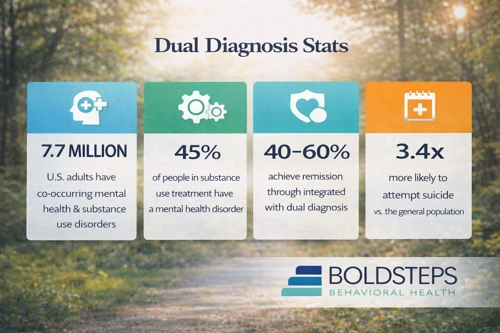
What Dual Diagnosis Treatment Looks Like (Without the Stereotypes)
Forget what you think treatment looks like. At Bold Steps, our dual diagnosis treatment in Merrimack County, NH is structured, yes—but also deeply personal. There’s no forced conformity, no pressure to become someone bland.
Here’s what you can expect instead:
- Integrated mental health support: For anxiety, depression, trauma, bipolar, and more—without dismissing your emotions
- Addiction care that’s trauma-aware, nonjudgmental, and rooted in science—not shame
- Creative expression through therapy, art, and safe community outlets
- Medication options, when needed, chosen with you, not for you
- A team that listens—really listens—to who you are and what matters to you
You won’t be treated like a case file. You’ll be seen as a whole human—complex, layered, and worthy of care that meets you where you are.
You’re Not Boring Without the Chaos—You’re Becoming Free
Let’s name the real fear:
“What if this intensity is the only interesting thing about me?”
We hear it. Loud and clear. And we’re here to say:
You are not your crisis. You are not your coping. You are not your past survival.
Underneath the habits and the hurt is still you. And when recovery is done well—when both your mental health and substance use are treated together—it doesn’t dull your edges. It teaches you how to carry them without bleeding.
What If You’re Not Ready? (That’s Okay, Too.)
You might not feel ready. You might still be unsure whether your symptoms “count,” whether your substance use is “bad enough,” or whether treatment can actually help.
You don’t need all the answers before you reach out.
What you do need is the space to ask better questions:
- “What if I could feel things fully without falling apart?”
- “What if my creativity could thrive in calm?”
- “What if I don’t have to lose myself to save myself?”
Dual diagnosis treatment at Bold Steps is a place where those questions are welcomed, not judged. You don’t have to be perfect. You just have to be open.
FAQs About Identity and Dual Diagnosis Treatment
Will treatment change my personality?
No. Dual diagnosis treatment helps you manage the parts of your mental health and substance use that are disruptive—not your personality. You’ll still be you—just with more stability and clarity.
I’m afraid medication will dull my emotions. Do I have to take it?
Not necessarily. Medication is one of many tools. If used, it’s chosen collaboratively—and monitored carefully to ensure it supports (not suppresses) your emotional and creative life.
Can I still be creative in treatment?
Absolutely. Many of our clients rediscover their creativity in new, sustainable ways once they begin treatment. We offer expressive therapies and space for you to stay connected to your creative self.
What if I don’t feel “bad enough” for treatment?
If you’re asking the question, something in you knows it’s worth exploring. You don’t need to hit a dramatic bottom to deserve support. Exhaustion, disconnection, or just wanting more is reason enough.
What Comes Next Is Yours to Decide
At Bold Steps Behavioral Health in New Hampshire, we believe healing should feel like coming home to yourself—not walking away from who you are. If you’ve been afraid that recovery means becoming someone else, we want to show you what’s possible when you’re allowed to keep your voice, your spark, and your story.
Call (603)915-4223 to learn more about our dual diagnosis treatment services in New Hampshire.