

Loving someone who’s still drinking can feel like holding on to someone who’s already slipping away. You see who they used to be. You remember the softness, the laughter. But now? You wake up bracing for the next wave: a broken promise, a missed call, another night that ends in silence or shouting.
If you’re wondering whether alcohol addiction treatment can help—even when your partner isn’t ready—you’re not alone. Many spouses, partners, and loved ones feel stuck in the same in-between space: committed to love, unsure how to help, and unsure how much more they can take.
At Bold Steps Behavioral Health in Concord, NH, we walk alongside families—not just the person in treatment. This blog is for you. Whether you’re holding it all together or falling apart, this is a space to sort through what alcohol addiction treatment can do for couples—and what it can’t do when one partner is still using.
It Can Help You Heal—Even If They’re Still Drinking
Your healing doesn’t have to wait for theirs.
It’s a painful myth that only the person with the addiction needs help. In truth, addiction affects the whole system. If you’re waking up anxious, walking on eggshells, or constantly managing chaos that isn’t yours, you’re in the blast zone.
Individual therapy, family counseling, and support groups can offer a space where you are the focus. Where your pain isn’t compared, minimized, or ignored.
Sometimes, just hearing “You don’t have to keep doing this alone” can change everything.
It Can’t “Save” the Relationship On Its Own
Treatment is not couples therapy with a cape.
Even the best alcohol addiction treatment program can’t rescue a relationship if both people aren’t doing the emotional work. Recovery can bring couples closer, but only when honesty, accountability, and shared commitment are present.
If one partner is still drinking and the other is in treatment, the path forward may not be a shared one. That doesn’t mean failure—it means honesty. And sometimes, loving someone includes loving yourself enough to leave or pause.
It Can Help You Name the Crazy-Making Dynamics
You’re not imagining it—and you’re not overreacting.
Loving someone in active addiction often means second-guessing yourself. They may minimize, deny, or blame. Over time, your instincts get buried under confusion.
Treatment offers language and clarity:
- Codependency
- Gaslighting
- Emotional labor
- Hypervigilance
- “If I just…”
When you have words for what you’re living through, you start to see it clearly. And when you see it clearly, you can begin to make choices that serve you—not just survive the situation.
It Can’t Force Them to Change
No one can choose recovery for someone else.
No therapist, no family member, no amount of pleading or love. That truth hurts—especially when you’ve built a life together.
Treatment can help you understand the psychology of addiction. It can help you set limits that feel loving but firm. But it can’t control their choices. If they’re not ready to stop drinking, treatment can’t make them ready.
What it can do is help you stop internalizing their behavior as your fault. That shift alone can be life-altering.
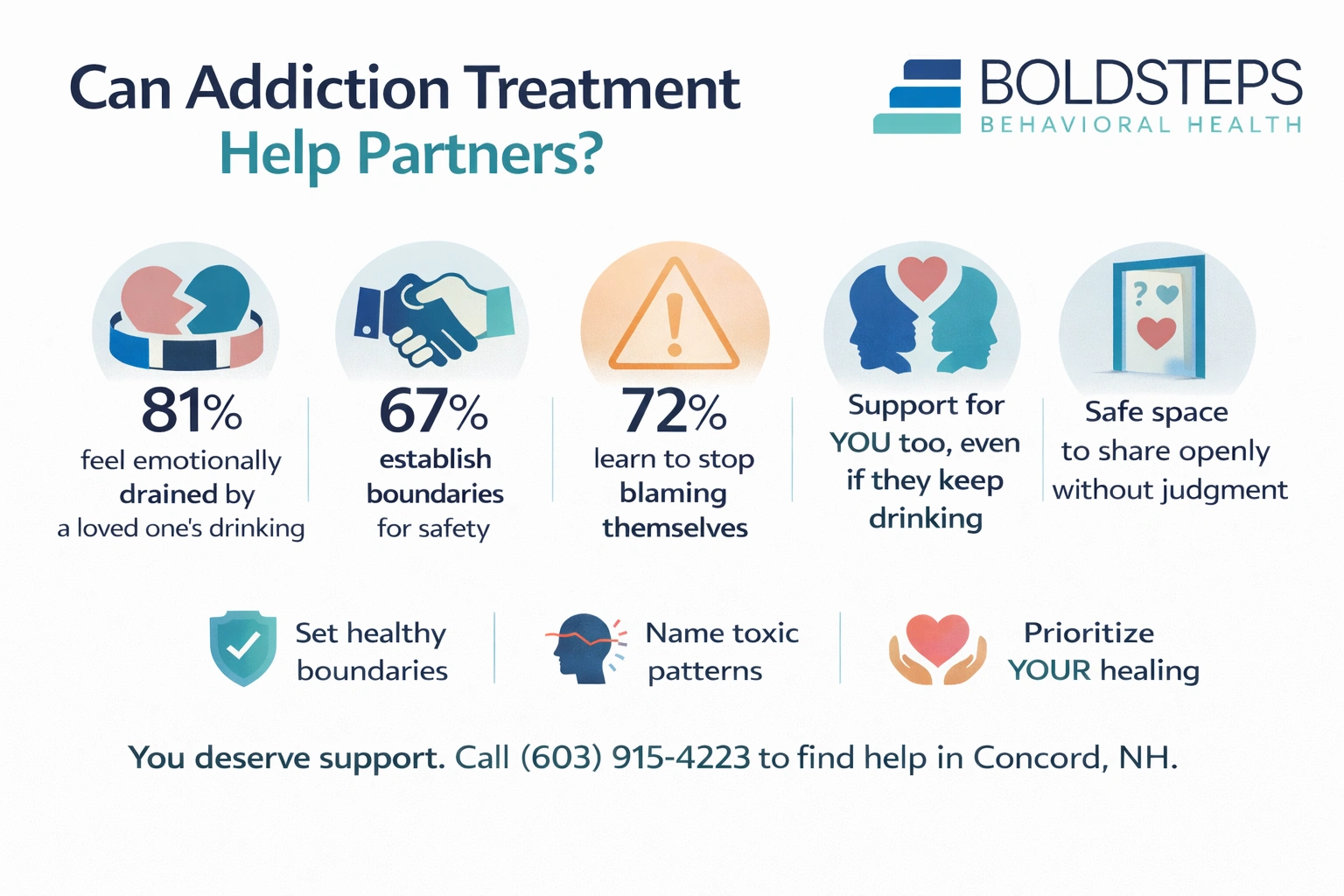
It Can Support You in Setting Boundaries You Can Live With
Boundaries aren’t cold—they’re clarity.
When someone you love is actively using, the lines between love and harm blur fast. You may start doing things you never thought you would: lying to friends, covering for missed work, hiding the truth from your kids.
Treatment can help you define your non-negotiables. And not just what they are—but how to hold them.
Some examples:
- “If you drink and drive, I will call the police. Not to punish you—but to protect others.”
- “I will no longer lie to your boss about your drinking.”
- “I won’t allow you in the house when you’re intoxicated around the kids.”
Boundaries aren’t about control. They’re about safety—for everyone involved.
If you’re looking for alcohol addiction treatment in Rockingham County, NH, our team can help you explore what boundaries look like in your specific relationship.
It Can Offer Space to Tell the Truth Without Judgment
Sometimes, just saying it out loud is a relief.
Things like:
- “I’m scared to leave.”
- “I love them, but I don’t know who they are anymore.”
- “I don’t trust myself.”
These aren’t things most people say at book club or during lunch breaks at work. But they are safe to say in treatment. At Bold Steps, we create environments where partners can speak freely. Where the grief, confusion, love, and anger are all welcome.
Healing starts with truth. And truth needs space to land.
It Can’t Tell You What to Do—But It Can Help You Decide
Should you stay and wait?
Should you leave and protect your peace?
Should you give it six more months and see?
We won’t answer those questions for you. That’s not our job. What we can do is walk beside you as you explore the answers. Therapy doesn’t push an agenda—it helps you listen more clearly to your own values, your own truth, your own boundaries.
And whatever you choose, you don’t have to carry it alone.
FAQ: Common Questions From Partners Still in the Storm
What if I want help but they don’t?
Come anyway. Your healing is valid on its own. You don’t need your partner’s participation to begin caring for yourself.
Can couples go through treatment together?
Yes—but it depends on the level of care and each person’s readiness. If one partner is in active use and not willing to stop, most programs will recommend separate tracks at first.
Will treatment force me to leave my partner?
Absolutely not. We don’t make decisions for you. Our job is to help you build clarity and safety, not control your relationships.
What if I’m the one who wants to stop drinking, but my partner doesn’t?
That’s common—and hard. Treatment can help you stay committed to your own recovery while navigating the emotional toll of being with someone who’s not ready. You’ll need strong support. We can provide that.
Do you offer family or couples sessions?
Yes. We offer family counseling and education as part of many treatment plans. This helps partners explore the impact of addiction on relationships and begin building new communication tools—when both parties are ready.
It Can Support You—and Them—If They Choose Treatment Later
If your partner eventually chooses to enter treatment, your own healing work becomes even more important. Why?
Because recovery isn’t just about getting sober. It’s about building new dynamics—and that requires both people to show up with honesty, clarity, and readiness.
You’ll already have a foundation. You’ll know how to support without rescuing. You’ll have your own recovery lane. And that makes the couple’s recovery much more sustainable.
If you’re looking for alcohol addiction treatment in Merrimack County, NH, our programs offer couple-conscious support structures that center emotional safety.
You Deserve Support—Whether They Choose Help or Not
You don’t have to keep waiting in silence. Call (603) 915-4223 to find out how alcohol addiction treatment in Concord, NH can help you care for yourself, your heart, and your future.